Every business relies on proper ventilation, but some commercial spaces face greater challenges with dust, airborne particles, and HVAC contamination than others. High foot traffic, continuous HVAC operation, and activities that generate dust or debris can all affect how quickly a ventilation system becomes dirty.
So, which businesses should pay closer attention to their air ducts?
Restaurants, office buildings, hospitals, schools, hotels, retail stores, and warehouses are among the businesses that may need commercial air duct cleaning. These facilities have different ventilation demands, and cleaning may be necessary when inspections reveal significant dust buildup, debris, microbial contamination, or other conditions affecting the duct system.
However, the need for cleaning depends on more than the type of business. Building usage, HVAC maintenance history, and the condition of the ductwork all play a role. Understanding these differences can help business owners and facility managers identify when professional air duct cleaning is worth considering.
Businesses That Need Commercial Air Duct Cleaning Services
Almost any business with a ducted HVAC system may need commercial air duct cleaning at some point. However, certain workplaces face conditions that make regular inspection especially important.
-
Office Buildings and Corporate Workspaces
Office dust doesn’t always stay on desks. Paper fibers, carpet particles, and everyday foot traffic contribute to indoor dust, while the HVAC system distributes air throughout the building. When vents repeatedly collect dust or certain rooms feel stuffy, the ventilation system may need closer inspection.
Consider an office where employees keep cleaning their desks, yet dust returns around the same air vents. The problem might involve indoor dust sources, dirty filters, or contamination inside the ductwork. An HVAC inspection can help determine the cause before management pays for unnecessary cleaning. The EPA’s research on indoor air quality examined 100 public and commercial office buildings across 37 cities in 25 states, highlighting the importance of understanding conditions inside commercial buildings.
When to investigate:
Persistent musty odors, dust following renovations, visible debris inside ducts, or recurring complaints about ventilation all warrant attention.
-
Restaurants, Cafes, and Commercial Kitchens
Cooking generates heat, moisture, odors, and airborne grease particles. Restaurants also run ventilation equipment for extended periods, which makes proper HVAC maintenance particularly important.
Two ventilation systems, two different cleaning needs:
- Air conditioning ducts: These ducts distribute cooled or heated air throughout dining areas, offices, and other spaces. Over time, dust and debris gets collected inside, making inspections important to determine when cleaning is needed.
- Kitchen exhaust ducts: Unlike AC ducts, kitchen exhaust ducts remove cooking fumes, smoke, and grease from the kitchen. Grease can build up inside the ductwork over time, so regular inspection and cleaning help control deposits and reduce fire risks.
Good to Know:
Cleaning the air conditioning ducts does not remove grease from kitchen exhaust ducts. Restaurant owners should identify the system that needs attention before booking a service.
-
Retail Stores and Shopping Centers
Customers walk into a clothing store and finds the fitting rooms stuffy. Another notices a persistent odor near the checkout area. These problems don’t automatically point to dirty ducts, but they can signal that the building’s ventilation needs attention.
Retail properties also vary greatly in size. Small boutiques may have a simple HVAC setup. While a shopping center can contain multiple ventilation zones serving individual stores, corridors, food courts, and common areas.
The practical priority: Inspect areas with recurring odors, poor airflow, or dust accumulation. Following renovations, check whether construction debris entered the ventilation system before returning the space to normal operation.
-
Hospitals, Clinics, and Dental Offices
Healthcare buildings cannot treat ventilation maintenance like an ordinary office cleaning task. Waiting rooms, examination areas, laboratories, and specialized treatment rooms may have different air filtration and ventilation requirements.
What Facility Managers Must Consider
- Applicable healthcare ventilation and infection prevention requirements.
- The correct cleaning procedures for sensitive or specialized areas.
- Proper containment of dust during maintenance.
- Moisture problems or contamination that require additional corrective work.
Routine commercial duct cleaning does not replace required filtration, ventilation controls, or infection prevention procedures. Healthcare facilities should use qualified professionals who understand the building’s specific requirements and can coordinate work without compromising sensitive areas.
-
Schools, Colleges, and Daycare Centers
Dust from books, furniture, outdoor activity, and construction can contribute to indoor contamination in educational buildings. Meanwhile, crowded classrooms and shared facilities place ongoing demands on ventilation systems.
Four Warning Signs Worth Investigating
Recurring dust around vents
Repeated buildup may justify checking the filters, surrounding environment, and accessible ductwork.
Musty classroom odors
Persistent smells can point to moisture, damp materials, contaminated components, or another indoor source.
Leaks near HVAC equipment
Water damage needs prompt attention to prevent continued moisture exposure and potential microbial growth.
Uneven classroom temperatures
Poor airflow may result from blocked ducts, dirty filters, balancing problems, or mechanical faults.
Schools should investigate the underlying cause rather than assume every complaint requires duct cleaning. Filter replacement, ventilation adjustments, moisture repairs, and professional cleaning may all play different roles in the solution.
-
Hotels and Hospitality Businesses
Hotel maintenance teams have a more complex job than keeping guest rooms spotless. They must maintain comfortable conditions across guest rooms, corridors, lobbies, conference halls, and dining areas, often while the property remains occupied. The best approach is to prioritize areas according to their condition and operational needs.
| Hotel area | Maintenance priority |
| Guest rooms | Investigate recurring odors and dust around vents |
| Lobbies and corridors | Check shared ventilation serving busy public spaces |
| Conference rooms | Review HVAC performance after heavy occupancy |
| Renovated floors | Inspect for construction dust entering ductwork |
| Restaurants | Assess HVAC ducts separately from kitchen exhaust systems |
Large properties may benefit from phased maintenance that allows inspections and necessary cleaning to take place with minimal disruption to guests.
-
Gyms and Fitness Centers
Gyms generate heat and moisture through physical activity, while locker rooms and changing areas may experience elevated humidity. Ventilation helps manage these conditions, but duct cleaning alone cannot correct every problem. Start with the source of the problem.
- Dust inside the ductwork may require professional cleaning.
- High humidity may require better ventilation or improved moisture control.
- Persistent locker-room odors may originate from drains, damp surfaces, or inadequate exhaust ventilation.
- Uneven airflow may point to dirty filters, blocked ducts, or mechanical problems.
Important:
Mold needs moisture to grow. If a gym has damp insulation, leaking pipes, or wet building materials, correcting the moisture source is essential. Cleaning the ducts without addressing ongoing dampness will not solve the underlying problem.
-
Warehouses and Manufacturing Facilities
Industrial buildings need a different approach because the type of work determines what enters the air. Warehouse storing packaged products may mainly deal with ordinary dust from packaging and movement. A manufacturing plant, however, might generate fine particles, chemical vapors, or combustible dust that require specialized ventilation and handling procedures.
Before Scheduling a Cleaning Service
- Identify the contaminant. Determine whether the buildup comes from stored goods, production activities, outdoor air, or another source.
- Check the system design. General HVAC ducts and industrial extraction ducts may require very different cleaning methods.
- Review safety requirements. Hazardous materials and combustible dust can require specialized procedures rather than conventional commercial duct cleaning.
- Control future buildup. Appropriate filtration, source control, and exhaust ventilation help reduce contamination at its origin.
For industrial facilities, the right cleaning method depends on the material involved and the purpose of the ventilation system. A professional assessment should establish those requirements before work begins.
Also read: Is Air Duct Cleaning Required for LEED Buildings?
How Do You Know When Your Business Needs Air Duct Cleaning?
Not every commercial building needs its ducts cleaned on a fixed annual schedule. The decision should depend on the system’s condition, the building’s use, and any signs of contamination. Look for these warning signs:
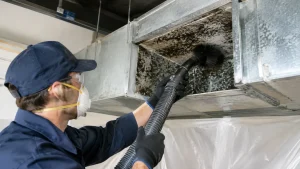
- Visible dust and debris: Significant buildup inside accessible ductwork or around system components may require further inspection.
- Persistent musty odors: Unusual smells may point to moisture, microbial growth, dirty components, or another indoor air quality problem.
- Recent construction or renovation: Drywall dust, sawdust, and other debris can enter HVAC systems if proper precautions are not taken.
- Water damage or damp insulation: Moisture inside or near ductwork needs prompt investigation and correction.
- Recurring dust complaints: Repeated dust accumulation may justify checking the HVAC system, although indoor sources can also be responsible.
- Unexplained airflow problems: Uneven airflow may result from blocked ducts, dirty filters, damaged components, balancing issues, or mechanical faults.
These signs do not automatically prove that the ducts need cleaning. A proper inspection helps determine whether duct cleaning, repairs, filter replacement, moisture control, or another solution is appropriate.
What Are the Benefits of Commercial Air Duct Cleaning?
When inspection confirms that cleaning is necessary, professional service can help businesses address contamination inside their HVAC systems.
Helps Remove Accumulated Dust and Debris
Dust and debris can collect in ductwork over time. Professional cleaning targets these deposits rather than relying on ordinary surface cleaning, which cannot reach the inside of the ventilation system.
Supports Better Indoor Air Quality Management
Indoor air quality depends on ventilation, filtration, humidity, pollutant sources, and HVAC maintenance. Removing significant contamination from ductwork can form part of a broader plan to manage indoor air quality. The Occupational Safety and Health Administration’s guidance on indoor air quality explains why proper building operations and routine HVAC maintenance matter in workplaces.
Helps Address Certain Odor Problems
Dust, debris, and contaminated materials inside the HVAC system may contribute to unpleasant odors. Cleaning can help when these deposits are the source. However, odors caused by plumbing problems, damp building materials, cooking exhaust, or other sources require a different solution.
Helps Maintain HVAC Equipment
Dirt and contamination affecting particular HVAC components can interfere with their operation. Identifying and cleaning affected components may support proper equipment performance. Duct cleaning alone does not guarantee lower energy bills or improved airflow. Those results depend on the actual problem and the condition of the entire HVAC system.
Supports a More Comfortable Workplace
Employees and customers expect a comfortable indoor environment. Persistent stuffiness, uneven temperatures, and unpleasant odors can make a business space less inviting. Cleaning may help address some problems when contamination is responsible, while ventilation adjustments, equipment repairs, and humidity control may be needed for others.
How Often Should Commercial Air Ducts Be Cleaned?
Commercial air duct cleaning does not follow one universal schedule for every building. Some systems may need cleaning after a renovation or contamination event, while others may remain in good condition for longer periods. The appropriate schedule depends on several factors:
- Building use: Restaurants, industrial facilities, and busy public buildings may face different contamination risks from ordinary offices.
- Occupancy levels: Buildings with many occupants may have different ventilation demands and indoor pollutant sources.
- Outdoor conditions: Nearby construction, dust, and other environmental sources can affect what enters the building.
- HVAC maintenance: Proper filtration and routine equipment inspections help identify problems before they become more serious.
- Moisture exposure: Water leaks, damp insulation, and microbial growth require prompt assessment and corrective action.
The U.S. Environmental Protection Agency’s guide to indoor air quality in office buildings explains how HVAC maintenance, moisture, building conditions, and pollutant sources affect indoor air quality. Rather than booking duct cleaning simply because another year has passed, arrange an inspection when conditions indicate a need. Follow the equipment manufacturer’s maintenance guidance and consult a qualified professional about the right schedule for your building.
Final Move: Does Your Business Need Commercial Air Duct Cleaning?
Commercial air duct cleaning is worth considering when dust, debris, moisture-related contamination, or other problems are found inside an HVAC system. Offices, restaurants, retail stores, healthcare facilities, schools, hotels, gyms, and warehouses may all need this service, but their requirements are not the same. The best approach starts with understanding the condition of your ductwork rather than paying for unnecessary cleaning. Regular HVAC inspections, proper filtration, moisture control, and timely repairs help businesses manage indoor air quality and keep their ventilation systems in good working order.
Omega Duct Cleaning helps businesses address dirty commercial air ducts with service suited to their building’s needs. Whether you manage an office, operate a restaurant, or oversee a busy commercial facility, start by identifying the condition of your ductwork and the areas that need attention. Don’t let an overlooked ventilation problem become another maintenance headache. Contact us to discuss your commercial air duct cleaning needs and determine the right next step for your business.
Frequently Asked Questions
Which businesses need commercial air duct cleaning?
Offices, restaurants, retail stores, schools, hotels, healthcare facilities, gyms, warehouses, and other buildings with ducted HVAC systems may need cleaning when inspections reveal significant dust, debris, or other contamination.
Does every commercial building need annual air duct cleaning?
No. Cleaning frequency depends on the building’s use, HVAC condition, contamination levels, and maintenance history. Inspection and professional recommendations are better guides than a universal annual schedule.
Can dirty air ducts affect indoor air quality?
Contaminated ductwork can contribute to indoor air quality concerns, depending on the type and extent of contamination. Poor ventilation, moisture, filtration problems, and indoor pollutant sources can also affect air quality.
Does commercial air duct cleaning improve energy efficiency?
Cleaning may help when dirt or debris is interfering with relevant HVAC components or airflow. However, energy savings are not guaranteed, and other issues such as dirty filters, mechanical faults, or poor system balancing may need attention.
How long does commercial air duct cleaning take?
The duration depends on the building’s size, ductwork layout, contamination, accessibility, and scope of service. A small office may require less time than a large warehouse or multi-story commercial building.
Is commercial air duct cleaning the same as HVAC maintenance?
No. Duct cleaning focuses on removing contaminants from ductwork and relevant components. HVAC maintenance can also include filter replacement, coil inspection, drain cleaning, mechanical checks, and airflow adjustments.
What should businesses check before hiring a duct cleaning company?
Ask about the inspection process, cleaning methods, equipment, scope of work, and any additional charges. A reliable provider should explain what needs cleaning, what the service includes, and whether other HVAC problems require separate attention.